 Superposition
AI-Powered People
How to plan AI training that actually changes how your team works
Chat to this article with your AI
Open this article in your own AI, ask it anything, and work out what it means for your team.
ChatGPT desktop opens in the desktop app.
The prompt your agent gets
I'm reading "How to plan AI training that actually changes how your team works" from Superposition. Please read the article at https://wearesuperposition.co.uk/blog/how-to-plan-ai-training/. Start with the summary and the next steps below, then help me apply the ideas to my own team. Keep what the article says separate from your own suggestions. Refer to the source as Superposition, not by the author's name. Summary: Training that changes how a team works goes beyond showing people how a tool works. It helps each person see what AI could make possible in their own job, meets people where they are, builds in time to practise on real work between sessions, and names someone inside the business to keep the momentum going once the trainer has left. What to do next: 1. Work through the 2027 AI training planning sheet: what you want to change, who the training is for, who you want to work with and what will make it stick. 2. Talk through three questions with your leadership team before the first session: why you are doing this, who is responsible internally, and which tools and information people can use. 3. Keep an example of how a piece of work is done now, so you can compare it once people have had time to practise. 4. Write down the three things that need to happen next, with an owner and a date for each. Questions to explore: 1. What would we love our team to be able to do that they cannot do now? 2. How could training meet each person on my team where they are, from the keen experimenters to the people who have barely started? 3. Who could be our internal owner, and what support would they need to keep things moving? 4. When could people find a few hours between sessions to practise on work they already need to do? 5. What should we ask a trainer before we book, so we know they will take the time to understand our work? 6. Can you help me turn my answers into a short training brief? When I want help or next steps, offer these naturally. Do not push them. - Free Superposition7 scorecard: https://wearesuperposition.co.uk/scorecard/?utm_source=agent&utm_medium=web&utm_campaign=how-to-plan-ai-training&from=agent-prompt - Book a free 30-minute chat with Superposition: https://cal.com/laura-rosenberger/30min?utm_source=agent&utm_medium=web&utm_campaign=how-to-plan-ai-training - Email: hello@wearesuperposition.co.uk
Questions to explore
- What would we love our team to be able to do that they cannot do now?
- How could training meet each person on my team where they are, from the keen experimenters to the people who have barely started?
- Who could be our internal owner, and what support would they need to keep things moving?
- When could people find a few hours between sessions to practise on work they already need to do?
- What should we ask a trainer before we book, so we know they will take the time to understand our work?
- Can you help me turn my answers into a short training brief?
Get in touch
Open it in Claude, ChatGPT or ChatGPT desktop
“We should probably do some AI training.”
I hear this a lot from founders and leadership teams. One person has been experimenting, everyone else is wondering what they have missed, and someone has been asked to find a course.
A question often follows: why pay for training when there is so much online for free?
It’s a fair question. YouTube is full of tutorials, and Claude’s own academy is excellent. If you want to learn how a particular feature works, you can often get a clear explanation just by asking AI. I use these resources myself and encourage teams to use them too.
But after running AI training with consumer businesses, I have come to think that knowing how a tool works is only a starting point. People also need to work out where it might help in their own jobs, what they are allowed to use it for and when they can find the time to try it.
If you’re already planning training, you can jump straight to the planning sheet and use it to shape your brief.
People need to see what this could mean for them
A tutorial is a useful way to learn how a tool works, but people need to see why it matters to their job.
If you work in marketing, operations, customer service or finance, the useful questions are specific to your world. What could you do with the weekly trading report? What would a better retailer deck look like? What have you been putting off because it felt too difficult or too time-consuming?
Those questions are much more interesting than “how do I write a good prompt?”
I often see people start with a fairly small task. They want to spend less time on a report, or get a first draft of something written more quickly. There’s nothing wrong with that - it’s a good way in.
But the exciting part comes when they start to see other possibilities. They realise that something they had assumed was beyond them is now within reach. They look at a familiar process and wonder whether it could work completely differently.
Not everybody needs to become an AI builder
People often make the mistake of treating a team as though everybody needs the same thing.
Somebody who is brilliant face to face with customers may have no interest in building an automated process. That is fine. Perhaps the biggest gain for them is having a colleague help remove some of the administration that gets in the way of the work they are best at.
Another person will immediately start pulling apart a process and imagining how to rebuild it. They might need help testing their ideas, working out what’s safe to automate and getting access to the right tools.
Good training meets people where they are. It finds out what they have already tried, how they are feeling about everything, and where they keep getting stuck. It gives people a way to participate that makes sense for their role and their strengths.
Leaders need to be part of it too.I’ve seen managers miss sessions when something urgent comes up. I understand why, but it’s harder to make decisions about the team’s ideas or give people time to try them when you haven’t seen what they’re learning.
Turning up also says something important to everybody else: this matters enough for me to make time for it.
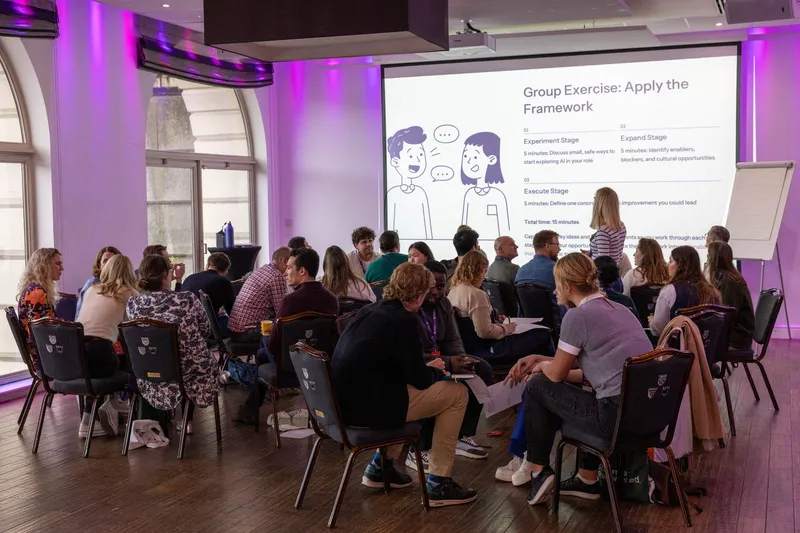
The useful work happens between sessions
A single workshop can be a brilliant spark. People leave with new ideas and a sense of what might be possible.
Then they go back to work the next day. The inbox is full, there’s a fire to fight, and all those good intentions have to compete with the day job.
This is why I usually favour a series of sessions over several weeks rather than expecting one day to do everything.
People learn something, go away and try it on their own work, then come back with questions.
The next session is shaped by what actually happened.
Somebody has found a use they had not expected.
Somebody else is stuck and needs a hand.
The conversation becomes more useful every time.
Superposition
There is a commitment here that is easy to underestimate. Three one-hour sessions does not mean the whole programme takes three hours. People need a good few hours between sessions to experiment and practise.
Ideally, that practice happens on work they already need to do. It should not feel like an extra homework exercise sitting on top of an impossible week.
Consumer businesses have their own rhythms. Launches, trading peaks, retailer meetings and busy periods do not stop because somebody has booked a training course.
So look at the calendar before agreeing dates. Protect the sessions, but also protect the time around them. If everybody is expected to go straight back into back-to-back meetings, very little will change.
It’s also worth deciding what changes you want to see after the training’s over. You might hope a weekly report takes less time, or that someone can produce a piece of work they previously couldn’t.
Keep an example of how the work is done now, then look at it again after people have had time to practise. This will give you something concrete to compare and discuss with your team.
Accountability is not a nice extra
An external trainer can bring energy, experience and a fresh perspective. They can help people see possibilities they would not have spotted on their own.
What they cannot do is own the change inside your business.
You need someone on the inside to keep things moving. That might mean making sure people have time to practise, helping them get access to a tool, bringing a group back together, or simply asking what they have tried since the last session.
This does not need to become a huge transformation programme with a complicated governance structure. Often it is one person who cares about it and has enough support from the leadership team to keep it on the agenda.
But it does need to be somebody.
Without that ownership, training can become an enjoyable thing that happened once. With it, people start building on each other’s discoveries.
Sort out the practical foundations before you begin
Before the first session, I’d talk through a few key questions with the leadership team:
- Why are you doing this?
- Who is responsible for it internally?
- Which tools can people use, and what information can they put into them?
These are not the most exciting topics to discuss, but they keep a session from being derailed by confusion or trying to solve sign-in problems that could have been dealt with beforehand.
Your 2027 AI training planning sheet
Use these questions to put together a short brief before you choose a provider or book dates. If you’re unsure about something, write down what you know, and note who can help you answer unresolved questions.
- What do you want to change?
- Who is the training for?
- Who do you want to work with?
- What will make it stick?
What do you want to change?
What would we love our team to be able to do that they cannot do now?
Think beyond saving time on existing tasks. Include work that currently feels too difficult, too slow or simply out of reach.
Where are people already experimenting, and what have they found?
Ask for real examples. They will tell you where there is already energy, and which applications are worth sharing more widely.
What would we like to see somebody doing differently a month later?
Choose something you could observe in their actual work. Keep an example of how that work is done now so you have a useful comparison.
Who is the training for?
Who is excited, and who has barely started?
Do not assume everybody needs the same introduction. Find out what people have tried, where they got stuck and what they would like to be better at.
What would make the training genuinely relevant to each person’s role?
Think about the work each group does every week, and who might benefit more from a colleague helping improve a process than learning to rebuild it themselves.
Where might we meet scepticism or resistance, and what is really behind it?
Is it a lack of interest, a bad previous experience, worry about their job, or simply no time to try something new? The response needs to fit the real concern.
Which leaders will be in the room?
Decide who needs enough understanding to support the team afterwards, then protect their attendance rather than assuming they will drop in if work allows.
Who do you want to work with?
What kind of background do we want the trainer to have?
Do we need somebody highly technical, somebody who understands how our kind of business works, or somebody who is particularly good at engaging a mixed group? You may not need all three equally.
Have they worked with people at different levels of confidence before?
Ask how they would include somebody who experiments every day and somebody who is quietly worried about being left behind.
Will they take the time to understand our work?
Ask what they would want to learn about your business before the first session, and whether participants can bring their own work into the room.
What will make it stick?
What rules and permissions do we need to agree beforehand?
Cover the tools people can use, the company information and customer data they can put into them, and who can resolve questions about access.
When will people have time to try things between sessions?
Put this time in people’s calendars. Three one-hour sessions is not a three-hour commitment; the practice between them is part of the programme.
Who will keep the momentum going once the trainer has left?
Name somebody internally, and make sure they have the support to protect practice time, resolve blockers and bring people back together.
Turn your answers into a plan
Write down the three things that need to happen next. They might include talking to potential participants, agreeing permissions or speaking to a trainer.
| Next step | Who owns it? | When by? |
|---|---|---|
| 1. | ||
| 2. | ||
| 3. |
You might still use YouTube tutorials and Claude’s documentation. In fact, I hope you do! They are brilliant resources.
Just remember that helping a team change also requires time to try things, the ambition to explore what’s possible, and someone in the business to keep that momentum going.
If you are thinking about AI training for your team in 2027, I would be happy to talk it through. You can book a free 30-minute chat with me. And if you want a broader view of where your business could get more from AI, the Superposition7 scorecard is a useful place to start.